The 3 Gunas That Explain Every Reaction You’ve Ever Had — and the Case That Proves It
Apr 08, 2026
There’s a person you know who walks into a room and you immediately relax. The tension in your shoulders drops. You don’t know why — they haven’t said a word yet. You just feel lighter.
And then there’s someone else. They walk in and your jaw tightens. Your thoughts get louder. The energy shifts, and you’re not sure if you want to move toward them or find the nearest exit.
What’s actually happening there?
Vedic psychology has a precise answer. It’s been sitting in ancient texts for thousands of years. And it’s the same framework that explains one of the most disturbing minds of our time.
What Are the Three Gunas — and Why Do They Matter?
The three gunas — sattva, rajas, and tamas — are the three fundamental qualities operating through everything in nature, including your mind, your mood, and the way you show up in every single interaction.
They are not personality types. They’re not fixed states you’re locked into. They are fluctuating energies moving through you constantly — shifting with what you ate, the conversation you just had, the text message you just read, the time of day.
Most of us carry all three, moving between them fluidly. That’s healthy. That’s human.
But what happens when one of them takes over completely — and nothing checks it?
That question has a case study. And we’re going to use it.
Sattva — The State of Clarity and Presence
When someone is in sattva, you feel it before they speak. There is a quality of calm around them — not passive calm, but grounded calm. Decisive. Clear. You feel safe to open up. You feel like you can slow down.
The sattvic mind knows what it wants. It makes choices aligned with its values without drama and without second-guessing. When chaos is happening around a sattvic person, they don’t add to it — they quietly reduce it. They become the still point in the room.
The sattvic person does not need anything from you. They are already full. That’s why being around them feels like relief.
Rajas — The State of Passion and Drive
Rajas is energy. Drive. Hunger. The rajasic person commands the room — not necessarily through force, but through sheer vitality. You look at them and feel something activate. Either excitement, because their energy is contagious — or irritation, because it’s a lot.
The rajasic mind is always in motion. Big plans. Bold ideas. Passionate opinions. Rajas is the only state that actually generates action. Without it, nothing gets built.
But rajas also carries impatience. Pride. A subtle quality of wanting — wanting to prove something, to achieve something, to have something. That hunger is what gives the rajasic person their edge. It is also what makes them exhausting if you’re in a quieter state.
Here is what Vedic psychology makes clear: there is nothing wrong with rajas. The goal is not to become purely sattvic and abandon ambition. The goal is to have sattva — clarity, conscience, presence — guide where your rajas takes you.
Without that guide, rajas becomes a machine. It produces. It acquires. It consumes. And it doesn’t stop to ask whether it should.
Tamas — The State of Rest, Inertia, and Heaviness
Tamas is the heaviest of the three states. It moves slowly. It accumulates. It looks like lethargy, laziness, selfishness, greed, confusion, indecisiveness, apathy, and at its extreme - depression.
But Vedic Psychology refuses to make tamas purely the villain.
Tamas is sleep. Without it, we unravel. The capacity to rest, to stop, to switch off — that is tamas. In balance, it is restoration. Out of balance, it is stagnation.
There is another face of tamas that is less discussed: the tamas of silence. The inertia that keeps people frozen when they should act. The heaviness that makes a room go quiet when it should speak. That quality of tamas is at the center of the case study we’re about to look at.
The Part Nobody Tells You About the Gunas
Here is where it gets interesting.
How you react to someone else’s state reveals your own.
When you see someone in deep rajas and feel energized by it — that’s your own rajas recognizing itself, and liking it. Conversely, when the same rajasic energy makes you feel anxious or irritated — that may be your sattva saying, this is too much.
Your reactions are a mirror. They’re not random. They’re not just personality. They are the constant, moment-to-moment broadcast of which guna is currently running you.
If you’re not aware of that, you are being moved by forces you cannot name.
“The action we can see. But if you can go back a little and see the feeling and the thought behind it — that’s where everything changes.”
— Dr. Joshi
CASE STUDY
The Epstein Files — What the 3 Gunas Reveal About the Most Disturbing Mind of Our Time
I want to be clear about what this is and what it isn’t.
This is not a true crime analysis. It’s not sensationalism. I have zero interest in that — and I suspect neither do you, or you wouldn’t still be reading.
This is a psychology analysis. We are using the three gunas as a diagnostic lens, exactly the way they were designed to be used — to make the invisible visible. To name what is happening beneath the behavior.
And here is why this case matters beyond the headlines: the forces at work in the Epstein story are not unique to him. They are human forces. Ancient forces. The same ones moving through every person you’ve ever encountered — including yourself.
That is not a comfortable thing to sit with. It is also the most important thing to understand.
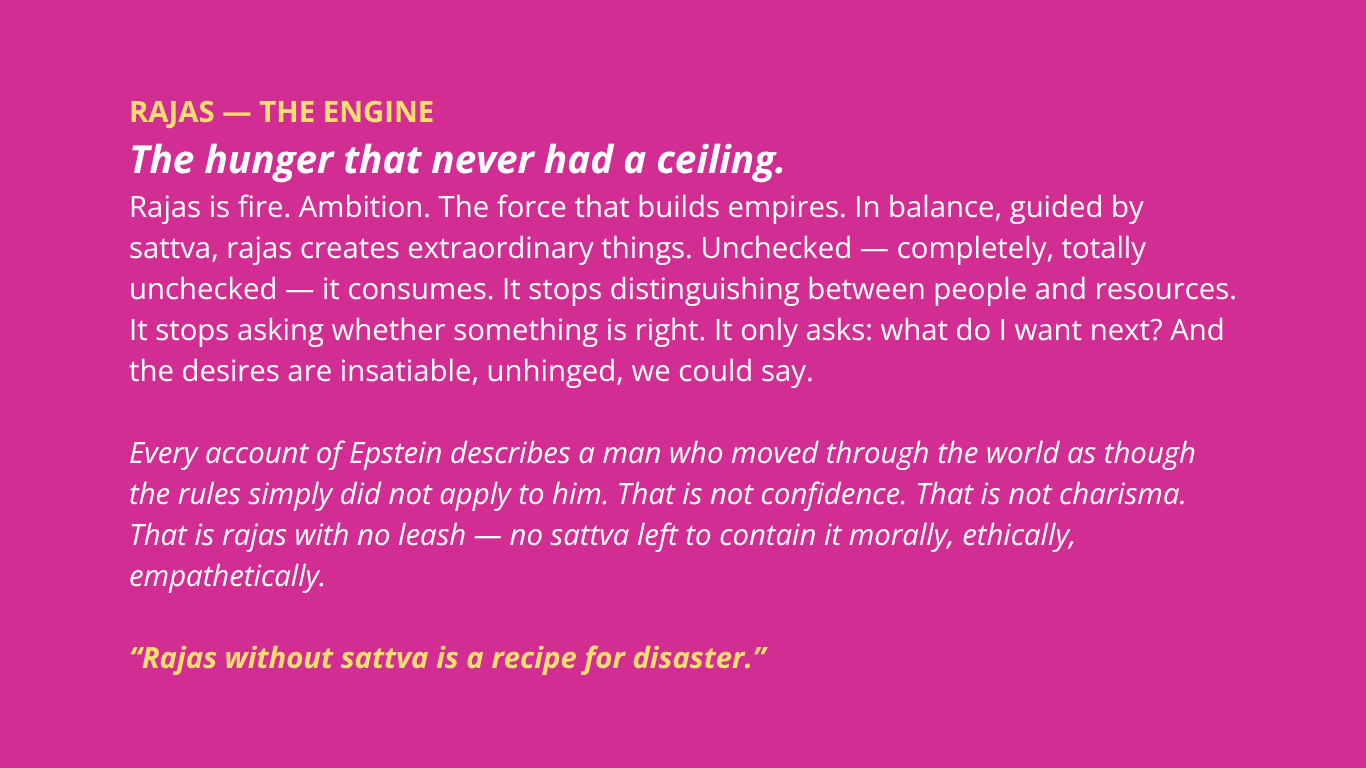
Rajas — The Engine That Never Had a Ceiling
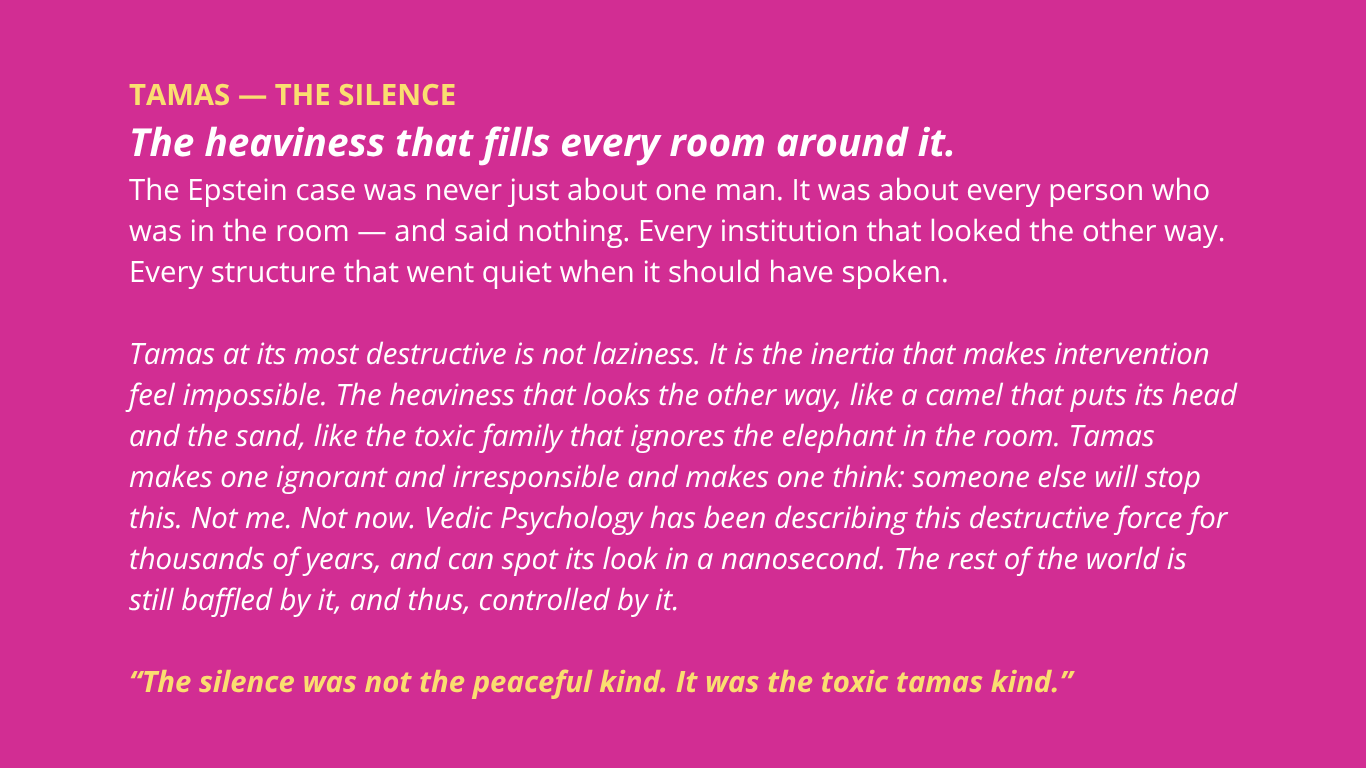
Tamas — The Silence That Made It Possible
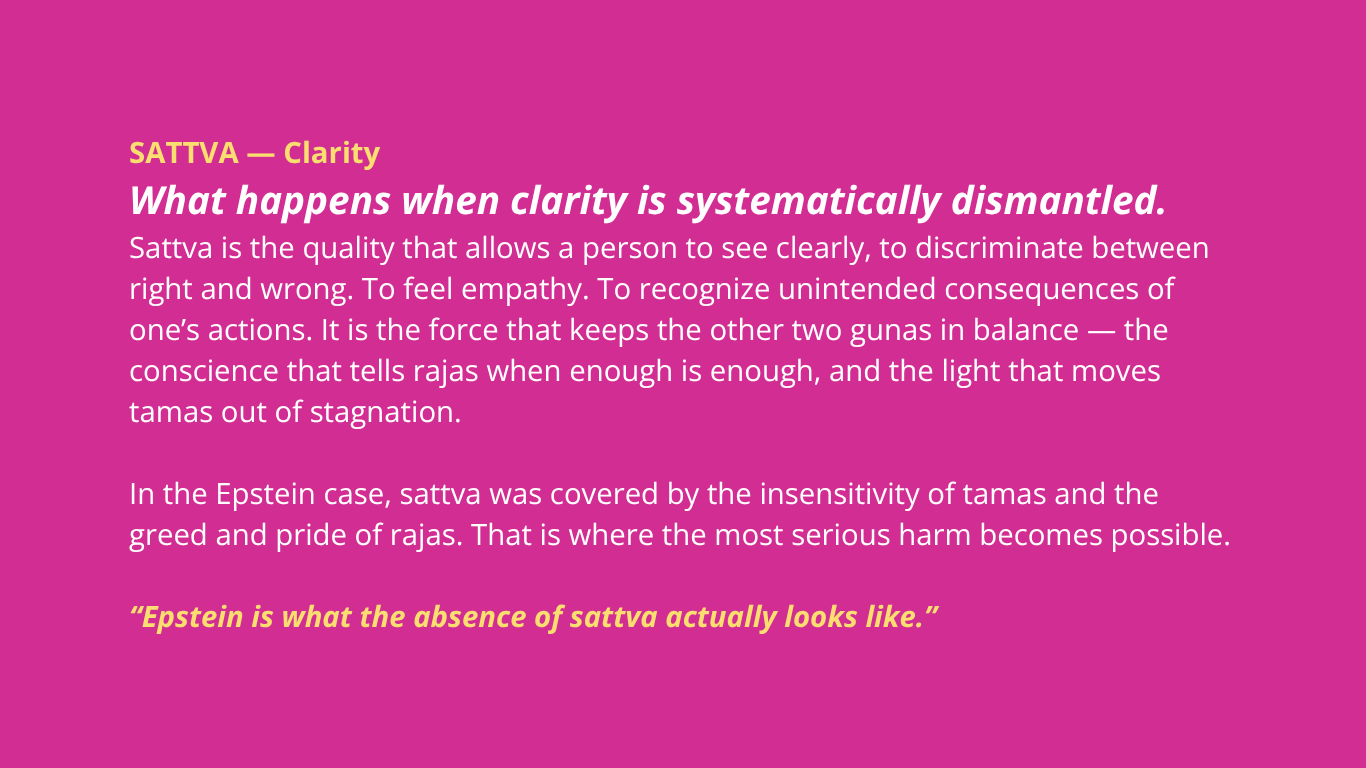
Sattva — What Happens When Clarity Disappears Entirely
What This Case Study Reveals About All of Us
This is not a case study about a monster. Monsters are easy — you can keep them at arm’s length, decide they’re nothing like you, and move on.
This is a case study about forces that live inside all of us. The rajas that sometimes takes more than it should. The tamas that has kept you silent when you should have spoken. The places in your own life where sattva has become covered by the lower natures.
That is what makes this work uncomfortable. And that is exactly what makes it so powerful.
The gunas are not a grading system. They are a diagnostic tool. An ancient, precise map of what is happening inside you and around you, every moment of every day. They help you decode the human mind in a matter of seconds by pinpointing the gunas the person is operating under.
Vedic Psychology has the keys to read this mind map, and learning it will save you lots of heartache.
“What you begin to see out there, you also start to recognize in here. That’s the real work.”
— Dr. Joshi
The First Step Isn’t Changing. It’s Seeing.
Self-awareness comes before transformation. Every time.
Before you can choose sattva, you have to notice your current mind state - is it reactive rajas or timid tamas?
Before you can understand the forces at work in the world around you — in the Epstein story, in your family, in your workplace, in your closest relationships — you have to be willing to see those same forces in yourself.
That’s what Vedic Psychology actually is. It is not a spiritual concept, although the wisdom comes from the mouth of Sri Krishna Himself. Rather, Vedic Psychology is a precision instrument - a practical tool for self-knowledge. And what we can see clearly in ourselves, we can easily see in others.
FIND YOUR VEDIC MIND TYPE

Which guna is most dominant in you right now? Your reactions reveal the answer.
👉 Take the Free Vedic Mind Type Quiz here 👈
GO DEEPER — THE EPSTEIN FILES ARE COMING

The full Epstein case study — live analysis, the Vedic Psychology framework applied in real time, and a companion workbook — is happening inside the Vedic Psychology Study Group.
Now is the time to jump in - every Saturday at 8:30am EST, we go deep. Real case studies. Group discussions that leave you seeing yourself more clearly than when you walked in.
👉 Join to Discuss the Eipstein Case Study 👈
Every Saturday · 8:30am EST · $149/month · Listen to Recordings · Cancel anytime
THE COMPANION WORKBOOK
A reflection guide for this session is available. Designed to take the three gunas off the screen and into your own life — so you can examine where rajas pushes past its limits, and where tamas keeps you silent.
👉 Download the Three Gunas Workbook ➔ 👈
For the latest on Dr. Joshi’s offerings: